

Projects
GNA NOW
A European collaboration aimed at delivering Gram-negative antibacterials with new modes of action to the clinical phase.
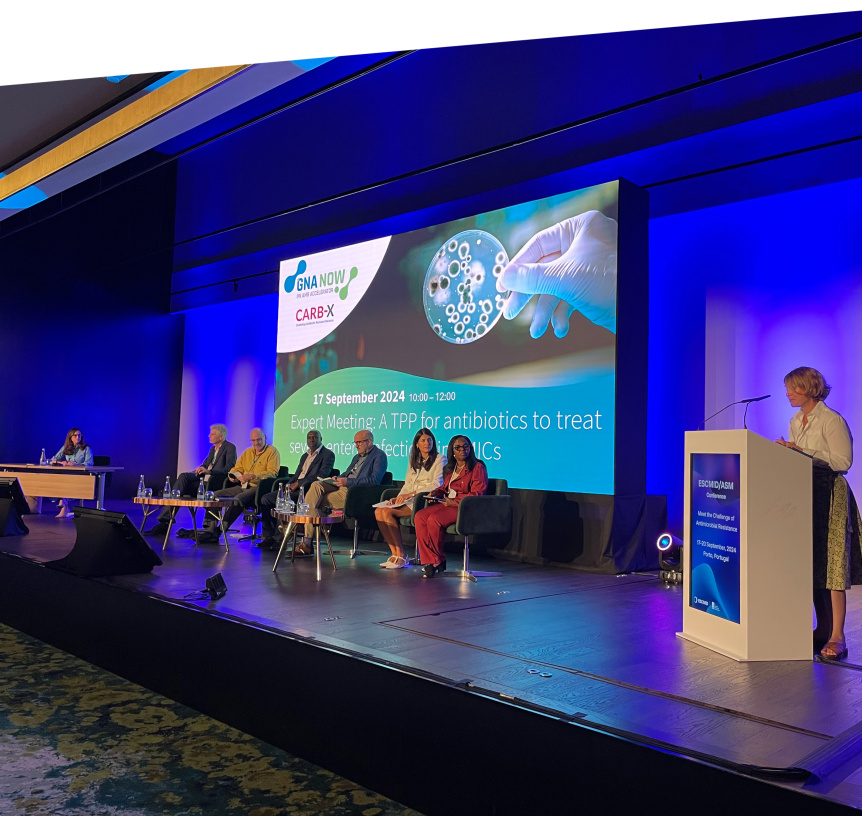
Antimicrobial Resistance (AMR) is a global and serious threat to human health. Gram-negative bacteria are widely regarded as the culprit representing many of the gravest dangers. Indeed, there is a dearth of new agents able to address AMR in Gram-negative bacteria, especially compounds with novel modes of action. Finding and developing such compounds represents a huge scientific challenge, one that requires the collaboration of stakeholders bringing many different kinds of expertise.

11
partners throughout Europe

€ 22 M
funding from IMI, EFPIA

Established in 2019 under the umbrella of the IMI (now IHI) AMR Accelerator, the GNA NOW Consortium (Gram-Negative Antibacterials NOW) is a joint initiative of 11 partners from industry and academia, aimed at delivering Gram-negative antibacterials with new modes of action to the clinical phase. The Consortium is focused on progressing treatments for severe diarrhoea, targeting four enteric pathogens: Shigella, Campylobacter, E. coli, and Salmonella. The Consortium consists of GSK (Scientific Lead), BioAster, Erasmus MC, Fraunhofer, Helmholtz Centre for Infection Research, Inserm, Medical University of Vienna, North Bristol NHS Trust, University of Liverpool, University of Poitiers, and Lygature (Coordinator). You can read more about the program on the AMR Accelerator website.
Operational and scientific leadership
As a neutral party with no conflicting interests, Lygature ensures that the agreed pre-set objectives of the consortium are reached within the six-year project term. In the particular complex and dynamic setting of GNA NOW, with the multi-consortia AMR Accelerator structure, and the ambitious project goals, many of Lygature’s qualities are mobilized, including:
- Operational coordination. Lygature leverages the vast experiences of managing public-private partnerships, interactions with IHI and stakeholder engagement to provide structure and process guidance.
- Scientific leadership. As coordinator of the GNA NOW grant, Lygature is co-responsible for strategic decisions regarding resources, scientific output, and progress towards the clinic, including attrition and replacement programmes.
- Agreement support. Lygature provides support in translation of the project in clear contractual language and well-balanced rights and obligations of all partners. Lygature monitors the continued adequacy of the agreement and guides, if required, accession of additional programmes.
- Stakeholder engagement. With the aim of contributing significantly to preclinical antibacterial development in the widest sense, Lygature contributes with best practices and support for capacity and knowledge exchange, funder interactions, and public patient involvement.
GNA NOW contributes to Lygature’s mission of accelerating the development of new treatments with important medical needs and a high societal impact. Lygature provides extensive management capabilities, and expertise as a custodian of trust, to move this multi-stakeholder research project forward.
Lygature together with


Acknowledgement of support
This project has received funding from the Innovative Medicines Initiative 2 Joint Undertaking (JU) under grant agreement No 853979: ‘GNA NOW: Gram-Negative Antibacterials NOW’. The JU receives support from the European Union’s Horizon 2020 research and innovation programme and is part of the AMR Accelerator.
Project updates
-
GNA NOW consortium expands its scope to support the under-studied condition of severe diarrhoea
Antimicrobial resistance (AMR) presents a worldwide challenge, disproportionately impacting the least developed nations. There is an urgent need to find innovative strategies to expand access to available antibiotics for conditions of high medical need in these geographies. Read more.
-

New publication
A new publication by members of the GNA NOW Consortium has been published by the American Society for Microbiology. The publication is based on work done under the Consortium's NOSO-502 program – a first-in-class Odilorhabdin antibiotic. Earlier this year, the program reached an important milestone with a Go decision to continue preparations for the first-in-human Phase 1 clinical study. This decision was a demonstration of the quality and innovativeness of NOSO-502, which has the potential to treat life-threatening multidrug-resistant infections.
Read the publication here. -
GNA NOW Consortium announces positive results for the late preclinical development of the first-in-class antibiotic NOSO-502
The GNA NOW Consortium, which Lygature proudly coordinates, has reached an important milestone with the completion of the GLP toxicology studies for its NOSO-502 program. The results allow for the further development of the program to Phase 1.