

Projects
GNA NOW
A European collaboration aimed at delivering Gram-negative antibacterials with new modes of action to the clinical phase.
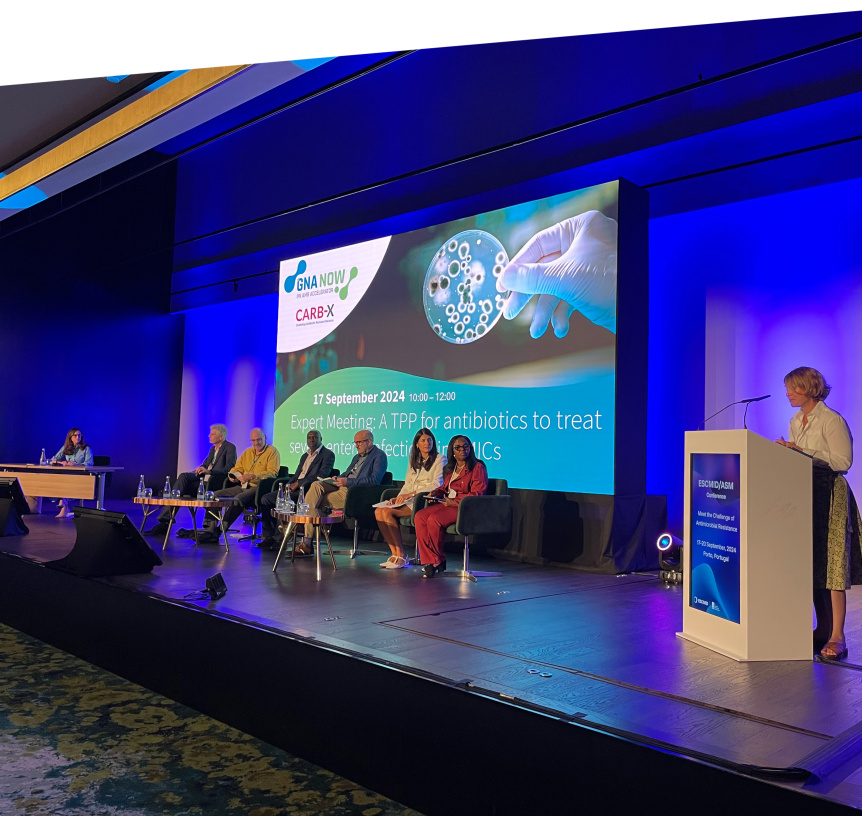
Antimicrobial Resistance (AMR) is a global and serious threat to human health. Gram-negative bacteria are widely regarded as the culprit representing many of the gravest dangers. Indeed, there is a dearth of new agents able to address AMR in Gram-negative bacteria, especially compounds with novel modes of action. Finding and developing such compounds represents a huge scientific challenge, one that requires the collaboration of stakeholders bringing many different kinds of expertise.

11
partners throughout Europe

€ 22 M
funding from IMI, EFPIA

Established in 2019 under the umbrella of the IMI (now IHI) AMR Accelerator, the GNA NOW Consortium (Gram-Negative Antibacterials NOW) is a joint initiative of 11 partners from industry and academia, aimed at delivering Gram-negative antibacterials with new modes of action to the clinical phase. The Consortium is focused on progressing treatments for severe diarrhoea, targeting four enteric pathogens: Shigella, Campylobacter, E. coli, and Salmonella. The Consortium consists of GSK (Scientific Lead), BioAster, Erasmus MC, Fraunhofer, Helmholtz Centre for Infection Research, Inserm, Medical University of Vienna, North Bristol NHS Trust, University of Liverpool, University of Poitiers, and Lygature (Coordinator). You can read more about the program on the AMR Accelerator website.
Operational and scientific leadership
As a neutral party with no conflicting interests, Lygature ensures that the agreed pre-set objectives of the consortium are reached within the six-year project term. In the particular complex and dynamic setting of GNA NOW, with the multi-consortia AMR Accelerator structure, and the ambitious project goals, many of Lygature’s qualities are mobilized, including:
- Operational coordination. Lygature leverages the vast experiences of managing public-private partnerships, interactions with IHI and stakeholder engagement to provide structure and process guidance.
- Scientific leadership. As coordinator of the GNA NOW grant, Lygature is co-responsible for strategic decisions regarding resources, scientific output, and progress towards the clinic, including attrition and replacement programmes.
- Agreement support. Lygature provides support in translation of the project in clear contractual language and well-balanced rights and obligations of all partners. Lygature monitors the continued adequacy of the agreement and guides, if required, accession of additional programmes.
- Stakeholder engagement. With the aim of contributing significantly to preclinical antibacterial development in the widest sense, Lygature contributes with best practices and support for capacity and knowledge exchange, funder interactions, and public patient involvement.
GNA NOW contributes to Lygature’s mission of accelerating the development of new treatments with important medical needs and a high societal impact. Lygature provides extensive management capabilities, and expertise as a custodian of trust, to move this multi-stakeholder research project forward.
Lygature together with


Acknowledgement of support
This project has received funding from the Innovative Medicines Initiative 2 Joint Undertaking (JU) under grant agreement No 853979: ‘GNA NOW: Gram-Negative Antibacterials NOW’. The JU receives support from the European Union’s Horizon 2020 research and innovation programme and is part of the AMR Accelerator.
Project updates
-

In conversation with GNA NOW Project Lead Eric Bacqué of Evotec
Antimicrobial Resistance (AMR) is a global and serious threat to human health and today, Gram-negative bacteria are widely regarded as the main culprit representing the gravest danger for patients. Established in mid-2019, the GNA NOW Consortium (Gram-Negative Antibacterials NOW) is focused on progressing new classes of Gram-Negative antibiotics from lead optimization to the completion of Phase I clinical trials. To find out more, we spoke with Project Lead, Eric Bacqué from Evotec.
-
GNA NOW: Successful first annual meeting
Despite the restrictions of Covid-19, the GNA NOW Consortium enjoyed a successful first annual meeting on Wednesday 24 June. Held online, the half-day meeting brought together 29 Consortium members to discuss the results achieved to date and the plans for the upcoming year.
The meeting got underway with an introduction from new project lead, Eric Bacqué (Evotec). This was followed by presentations from the various work package leads, with time built in for discussion between each presentation. Updates were also given on all of the project drug development platforms, data infrastructure, patient and public involvement, the activities of the Incubator Management Office, and the impacts of the Covid-19 crisis. The meeting ended with an overview of the ongoing communication and dissemination plans.
Commenting on the meeting, Kristina Orrling, GNA NOW Program Manager at Lygature said: “A year into the project, I'm delighted to see all three programmes progressing well. Thanks to clever teamwork and well-planned mitigation measures, the consortium has handled the Covid-19 situation in an exemplary way. While I missed the informal discussions of a face-to-face meeting, which often spark the really innovative ideas, the online meeting was a success – providing a comprehensive overview of project developments over the last year.”
Established in July 2019, the GNA NOW Consortium is a European collaboration of 11 partners focused on progressing Gram-Negative antibiotics from lead optimization to the completion of Phase I trials. Working under the AMR Accelerator umbrella, the project is funded by the Innovative Medicines Initiative (IMI) with in-kind contributions from industry partner, Evotec.
-

Efficient data exchange in the battle against antimicrobial resistance
Efficient data exchange respecting immaterial property and privacy is a requirement. As coordinator of GNA NOW, we’re happy to have such experienced and agile team for this task.
To fulfil the requirements of the GNA NOW partners, Fraunhofer, an established academic institute, has chosen to subcontract grit42. This illustrates how IMI-funded projects can provide a stage to innovative start-up companies to tailor-made products and services. In the end, it will not only be beneficial for the research, but also for innovation climate in Europe.
Read the full press release here.