

Projects
MMV-PDP
Identifying the next generation of medicines for the eradication of malaria: transmission blocking and relapse prevention
The MMV-PDP consortium aims to develop novel treatments to prevent relapse and block the transmission of Malaria. It brings together experts from The Netherlands and Africa, with contributions from academia, knowledge institutes, and small and medium-sized enterprises (SMEs).

10
partners from Europe and Africa

€8.8 M
funding from The Dutch Ministry of Foreign Affairs

About MMV-PDP
This drug discovery and development project ultimately seeks malaria medicines that target transmission and relapse – two areas of unmet medical need that are critical for the eradication agenda.
One subproject involves the so-called standard membrane feeding assay (SMFA), developed in Nijmegen, using high-throughput screening of the MMV screening deck to identify potential transmission blocking compounds. Substantial progress to date includes a class of very potent compounds (pantothenates), with the best leads being developed towards a clinical candidate.
The other subproject seeks new compounds to address infection relapse. Dormant parasites in some patients’ livers can cause new infections, sometimes years after initial infection and cure. A Dutch research group has established a unique in vitro and in vivo assay for testing compound activity against the hypnozoites, and even for exploring their relapse potential, using robust high-throughput screening.
MMV-PDP: Medicines for Malaria Venture - Product Development Partnership
Coordinating Dutch anti-Malaria efforts
Lygature is helping to drive project success, by managing a worldwide consortium of ten partners. From early 2016, a broad range of resources and support have been provided under the Lygature brand.
- Program management and leadership. Lygature is responsible for management of the program office, where organizational aspects of the program as a whole are coordinated. In addition, Lygature coordinates consortium meetings and dissemination efforts, both within the project and to the outside world. Lygature also monitors all reporting processes between the project members and the Dutch government.
- Program support. Lygature provides a custom-made IT platform for the safe exchange of data and other relevant information.
With diverse contributions from its ten partners across the globe, the MMV-PDP consortium presents a very significant management and communication challenge. Lygature offers the broad range of skills and experience needed to facilitate progress, and plays a key role in the consortium’s efforts towards addressing two crucial unmet medical needs.
Lygature together with
Medicines for Malaria Venture , TropIQ Health Sciences , Pansynt , Radboud University Medical Center , Biomedical Primates Research Center , Mercachem, Pivot Park Oss , Centre National de Recherche et de Formation sur le Paludisme , Radboud University
Project updates
-
Capacity building: West-African and Dutch researchers share knowledge in their fight against malaria
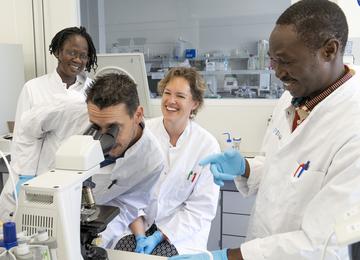
Above: A positive vibe at TropIQ Health Sciences when Noelie Henry and Samuel Serme where microscopically checking cultured malaria parasites together with Judith Bolscher and Tonnie Huijs. ©Martien Schouten
In 2018, Noelie Henry, PhD student at Centre National de Recherche et Formation sur le Paludisme (CNRFP), visited TropIQ Health Sciences to learn more about assay development and western drug discovery techniques. In turn, Judith Bolscher (Assistant Research Manager at TropIQ Health Sciences) visited the CNRFP in Ouagadougou, Burkina Faso, for a week in December 2018. Together with Koen Dechering (CEO of TropIQ Health Sciences), Teun Bousema (Professor of Epidemiology of Tropical Infectious Diseases at the Radboud University and Radboudumc) and Katharine Collins (postdoctoral fellow at Radboudumc) she went to share her knowledge on drug discovery technologies and to learn more from CNRFP’s experiences in the field.
The people at CNRFP are very driven and involved in malaria research. They all work towards the same ultimate vision: getting rid of the disease for good. Everyone has their own specific tasks and the organization works as a well-oiled machine. Next to explaining how she found herself privileged to have visited the organization and see how it works, she also explained how she went back to her normal workflow once back in the Netherlands: “It’s interesting to see how quickly you return to your old ways of working, habits and routines. But it showed me how quickly I could adapt to a new situation, which I think is essential for a healthy collaboration.”
Judith felt that the atmosphere in Africa was much more relaxed, and everyone is convinced things will work out well, which, as a result, is often the case. “It was very impressive to see how the researchers at the CNRFP deal with some challenges they face, like power outages, less financial resources and a more limited infrastructure to get resources in the lab. We take such things for granted in the Netherlands. The researchers at CNRFP almost always find a solution for the issues they’re facing, and otherwise they just wait for things to get better.”
Noelie also experienced a very positive vibe during the exchange visits: “Both visits were well organized, and the objectives were clear and precise. The team was very open and dynamic, and despite the short duration of the visits, we were able to do a lot of useful work and achieve tangible results that help us move forward in our search for a new anti-malaria drug.”
The experiments with patient materials and mosquitoes that were carried out in Burkina Faso are the starting point for a new visit in September 2019: they allow CNRFP to design a new ex vivo assay for testing anti-malaria drugs with the help of TropIQ.
“CNRFP and TropIQ are both excited for our next exchange. This time we will also try to include people from the Medicines for Malaria Venture to show them our progress in finding transmission blocking drugs. Teun and Katharine’s contacts in Burkina Faso have been essential in organizing the collaboration with CNRFP, which has been extremely fruitful for both organisations so far,” Judith said.
-
TropIQ Health Sciences wins Unilever Sustainable Innovation Prize
Lygature congratulates TropIQ Health Sciences on the Unilever Sustainable Innovation Prize. TropIQ is the Dutch innovative start-up best contributing to the Sustainable Development Goals as put forward by the United Nations.
-
World Malaria Day: Netherlands-based consortium teams up with MMV in world-leading malaria translational research program
Leiden (The Netherlands) and Geneva (Switzerland). Dutch life science public-private partnership organisation Lygature and Medicines for Malaria Venture (MMV) today announced the establishment of a Netherlands-based translational research consortium that will target the development of next-generation medicines to help eradicate malaria.