

News
AIMMS Festival explores the role of public-private partnerships in scientific challenges
VU Amsterdam recently organized the AIMMS Festival, a conference bringing together experts and thought leaders to discuss the challenges society faces in various scientific domains.
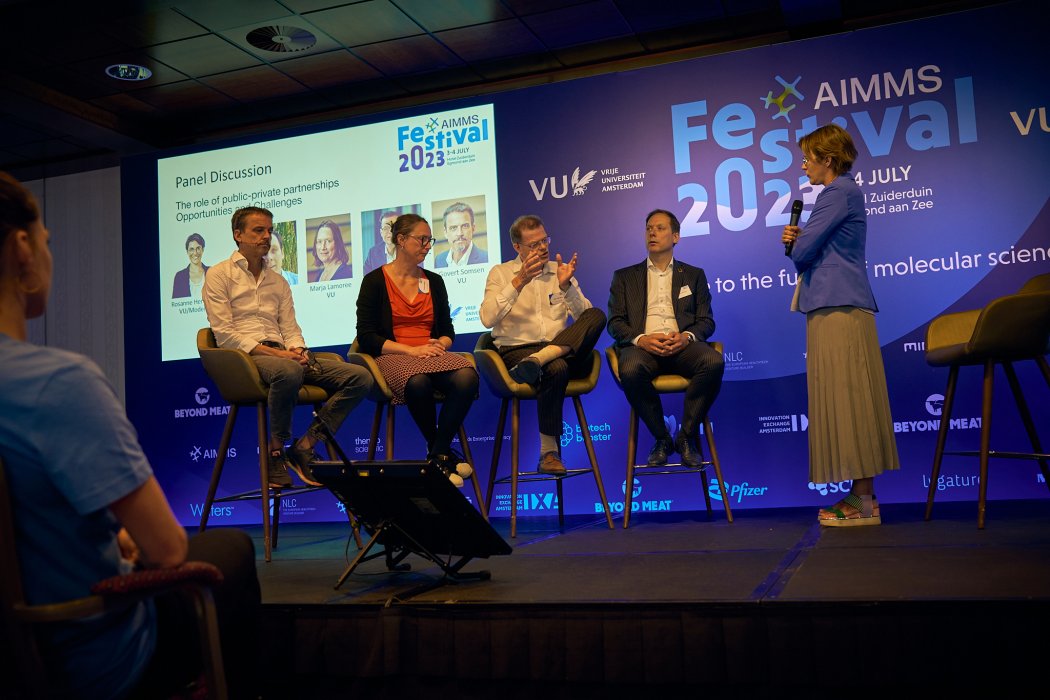
AIMMS is an interdepartmental research institute within the VU that stimulates interdisciplinary research in the field of molecular and life sciences. One of the key objectives of this year’s AIMMS Festival was to address challenges on AMR, personalized medicine, nutrition, toxicity, and (micro)plastics, and making connections between scientists and private partners.
A highlight of the conference was a panel discussion on public-private partnerships (PPP), moderated by microbiologist and publicist Rosanne Hertzberger. The panel consisted of industry experts and academic professionals, including Hans Roubos, Director of Digital Science and Technologies at DSM, Marja Lamoree, Professor of Analytical Chemistry for Environment and Health at VU, Govert Somsen, Professor of Biomolecular Analysis/Analytical Chemistry at VU, and Wim-Jan Koot, Business Director at Stichting Lygature.
Increased awareness
Rosanne initiated the discussion by introducing Wim-Jan, recognizing his experience and unique perspective having sat on all sides of the negotiation table in collaborative research initiatives. Wim-Jan shared his observations on the evolving nature of public private collaborations and the role of commercial entities in such partnerships. ‘There is an increased awareness among commercial parties that they can no longer work in isolation. I see a growing willingness to share valuable assets, including data and compounds.’
Wim-Jan KootIn public-private partnerships, decisions are made collectively, and all parties, including industry, have clear obligations and deliverables.
Throughout the discussion, Marja Lamoree expressed the critical perspective from academia, questioning the level of commitment from larger companies and their quest to get optimal results while minimizing financial contributions. Govert Somsen echoed some of Marja’s concerns, but in particular emphasized the time and energy wasted on non-scientific aspects of public-private partnerships, such as consortium agreement negotiations. In contrast, Hans Roubos shed light on the genuine intentions of public-private partnerships, emphasizing that even large companies recognize the need for collaboration due to the complexity of current research challenges.
Wim-Jan brought some nuances on the dynamics and intricacies of public private partnerships into the discussion. For instance, when addressing the perception that companies can solely direct collaborations due to their financial contributions, he clarified the distinction between contract research and collaborative research. ‘In public-private partnerships, decisions are made collectively, and all parties, including industry, have clear obligations and deliverables,’ he pointed out.
Growing pressure
The discussion also addressed the growing pressure on academics to seek industry funding, potentially compromising the freedom of research. There was a consensus among the panelists that while collaborations with industry can be beneficial, there is a need to strike a balance and ensure the independence of scientific research.
Bas TeusinkChallenges in society or industry inspire academic thinking, and industry realizes that they cannot be experts in everything.
Bas Teusink, CSO of AIMMS, says: ‘Making connections between academia and private partners is an essential aspect of academic research, and not all academics, and certainly the younger scientists, are aware of the possibilities, challenges, and opportunities. We thought a panel discussion was a good format to inform scientists about this. Having researchers, a private partner like DSM and Lygature was a great mix.’
His biggest take-away is that even though collaborations can sometimes be challenging in terms of contracts and other legal issues, great opportunities arise when public and private partners find each other and respect that they each play a different but essential role in driving innovation. He concludes: ‘Challenges in society or industry inspire academic thinking, and industry realizes that they cannot be experts in everything. Moreover, through PPP projects the universities train the people that will later work in R&D within companies. We need each other!’