

News
Discovering compounds that block malaria transmission: an interview with Dr Koen Dechering from TropIQ Health Sciences
To ensure the eradication of malaria, medicines need to be developed that kill parasites in all stages of life. This includes targeting the sexual stage (gametocytes) where parasites can re-infect mosquitoes and transmit the disease.
Discovering compounds that block malaria transmission has been a key focus of the Dutch government-funded MMV-PDP Consortium – a collaboration of seven Dutch partners, working together under the leadership of the Medicines for Malaria Venture (MMV) on antimalarial drug discovery.
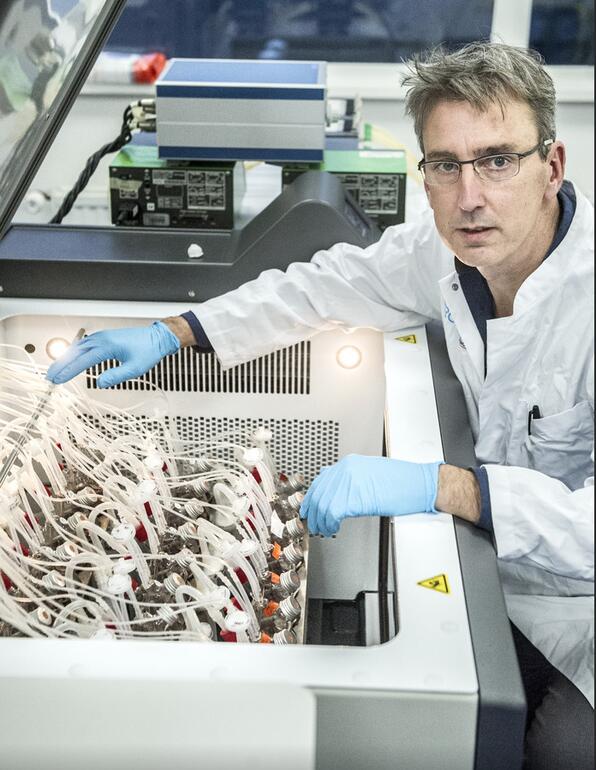
To learn more about the importance of gametocytocidal drugs and blocking transmission, we interviewed MMV-PDP project partner, Dr Koen Dechering from TropIQ Health Sciences. Koen has been involved in the MMV-PDP Consortium since its inception in 2015 and has been leading the Consortium’s transmission blocking/gametocytocidal sub-project – one of four workstreams funded by the Dutch government between 2015-2020.
What has been the focus of your work in the MMV-PDP Consortium?
I am the project lead of the transmission blocking/gametocytocidal sub-project, which aims to identify small molecules and starting points for novel drugs that help block the spread of malaria. This is something that current malaria drugs do not do. While current treatments kill the parasite stage that makes one sick, they don’t block the spreading of malaria. If we are ever to eradicate malaria, we have to develop drugs that target transmission.
What does this work entail?
To find molecules that block transmission, the classic experiment involves infecting mosquitoes with malaria parasites. Essentially, you culture malaria parasites in human blood and feed this to mosquitos in cages. A compound is added to the bloodmeal to test if it blocks mosquito infection. With this experiment, you can only test one compound. We have been looking for a way to increase the capacity of this classic test using a new technology we developed at TropIQ known as molecular insect barcoding. With this technology, we can feed mosquitoes on an array of bloodmeals and see where any given mosquito has been feeding and which particular test compound its bloodmeal contained. From this, we have identified a number of molecules that can block the infection of mosquitos.
Half of the world’s population is exposed to malaria. If we are ever to eradicate it, we have to develop drugs that target transmission.
Has the screening platform been applied to other projects?
Yes, we’ve also used it in a different project where we looked for molecules that kill mosquitos, instead of the parasite. This also identified a number of hit molecules, which we are still pursuing.
What can be done with your discoveries and compounds?
Ultimately, we hope to be able to develop a new drug candidate. We have worked on another MMV-PDP sub-project with pantothenamide, a compound that targets both the parasite stage that makes one sick and that which transmits the disease. This work has now delivered a clinical candidate that is moving towards the first in-human study. If funding is renewed, we hope to be able to do the same for this project.
What is the importance of gametocytocidal drugs and blocking transmission?
The cause of clinical malaria is only the tip of the iceberg when it comes to this deadly disease. There is an enormous reservoir of parasites in the population that do not necessarily cause acute illness. There are lots of asymptomatic malaria carriers who have the parasite, do not get sick, but still transmit the disease. This puts people with a weak immune system, like young children, at risk of becoming ill and even dying. To eradicate malaria, you have to target this reservoir of parasites that sit in asymptomatic patients as well as in mosquitos. Finding drugs that block transmission is one of the missing pieces of the malaria eradication puzzle.
Partnerships like the MMV-PDP consortium are really the way to go for neglected disease drug discovery projects.
How far are we from eliminating this problem and potentially eradicating malaria?
MMV has a very promising portfolio of molecules that are now in pre-clinical and clinical phases of development. Among those molecules are ones that block transmission, so they may have that attractive dual function of treating patients and blocking transmission. I think that malaria elimination will start at the edges of the malaria map – regions with low or very seasonal transmission like Mexico, Nepal, and South Africa. These are the regions where we should be able to eliminate malaria first and then work towards the hotspots of high prevalence in countries like the Congo or Cambodia.
How has your experience been working in the MMV-PDP Consortium over the last five years?
It’s been a real pleasure. It’s a fantastic bunch of people – great scientists and reliable partners who are extremely committed to this work. Thanks to this partnership, we were able to forge new relationships with the likes of MercachemSyncom (now called Symeres), a chemistry contract research organisation who helped optimise our research with their medicinal chemistry and synthesis expertise. This coming together of different skillsets is key to public-private partnerships like the MMV-PDP Consortium.
Through the Consortium, capacity building has been developed between researchers in the Netherlands and Burkina Faso. How has this enriched the project and the field?
We were very fortunate to start a collaboration with a lab in Burkina Faso. This has been an extremely enriching experience. We have helped them build their infrastructure and educate researchers, while they have provided us with knowledge of field research and access to research materials from Africa, such as malaria parasites from local patients.
Everything we do here in Europe is done with a lab strain of malaria, but we never get to test whether what we do works against African parasites from real patients. This capacity building has really added to our research and helped us better understand the situation on the ground in malaria endemic countries like Burkina Faso. When you work on malaria for a long time, it can become quite an abstract, technical problem. Every now and then, we need to be reminded that we are doing this work to save lives.
Would this knowledge exchange have taken place without the support of the Dutch PDP fund?
No, I don’t think so. The Dutch funding has been essential. Drug discovery is obviously risky business. Cancer drugs provide high-risk high-benefit, whereas malaria and other infectious disease drugs provide high-risk and little to no commercial benefit. Partnerships like the MMV-PDP consortium are really the way to go for neglected disease drug discovery projects. They combine the expertise and industrial mindset of biotech companies like ours with large pharma companies and organisations like MMV, and they bring in public funding to lower the financial risk. I really hope there is potential for future funding to continue this vital and valuable research.