

News
Lygature-facilitated ILLUMINATE project kicks off its activities
International consortium launches its activities to improve the approach to theranostics-based advanced stage cancer treatment while increasing the overall availability of radioisotopes.
Lygature is pleased to announce the launch of a new international consortium of academic and industrial leaders “ILLUMINATE” (Increasing lutetium production while leveraging metabolic imaging to enhance theranostics effectiveness). The collaborative research program aims to demonstrate the unique value of recently developed Metabolic Magnetic Resonance Imaging (MeMRI) visualizing chemical processes in the body to significantly improve effective application of theranostics – an approach combining diagnosis, treatment, and continuous follow up of a condition. ILLUMINATE will provide the first clinical translation of MeMRI, with application to castrate resistant metastatic prostate cancer. This will pave the way for future expansion of the technology for use in earlier cancer stages and in other cancer types. In parallel, ILLUMINATE seeks to increase the overall availability of lutetium and develop more sustainable production methods. ILLUMINATE is a four-and-a-half-year public-private partnership, funded by the Innovative Health Initiative (IHI). The consortium is coordinated by UMC Utrecht, together with NRG PALLAS as a project lead.

Role of Lygature within ILLUMINATE
Lygature was instrumental in the set-up phase of the ILLUMINATE consortium. In close collaboration with UMC Utrecht, Lygature coordinated and supported the application process for the project, followed by the contractual negotiations between partners. Setting up the ILLUMINATE project required extensive expertise in science, and partnership management. Within ILLUMINATE, Lygature provides program management and communication support.

Sophie Huiskes-Berends, Program Manager at LygatureNext to managing this truly innovative type of public-private partnership, Lygature contributes its regulatory expertise within ILLUMINATE
About ILLUMINATE
Prostate cancer is the leading cause of death in a quarter of the world’s countries and is the most prevalent non-cutaneous cancer amongst men in Europe. Major advances in treating prostate cancer have been achieved using selective targeting of therapy with antibody-radioisotope combinations. Lutetium-177-Prostate-Specific Membrane Antigen (Lu-177-PSMA) is a highly promising targeted radioligand therapy recently approved for metastasized prostate cancer. It delivers beta-particle radiation to PSMA-expressing cells and the surrounding microenvironment, thus destroying the tumour cells. Lu-177-PSMA treatment is a so-called theranostics approach wherein imaging (PSMA PET/CT before, during and after treatment) and treatment itself are based on the same administered peptide, i.e. PSMA.
Supplementing standard clinical care with Lu-177 treatment has significantly prolonged the survival in prostate cancer patients. Despite the success of Lu-177-treatment, not all patients respond to it. Around 30% do not benefit from the treatment but do suffer from the side-effects such as nausea and fatigue (in already strongly debilitated individuals). Moreover, while theranostics provide for individualized treatment, challenges remain to successfully implement this approach in clinical practice. There is a lack of objective criteria for treatment selection and monitoring to optimize efficacy and safety. This hampers treatment accuracy.
Current approaches used to predict and monitor treatment efficacy in prostate cancer lack key features to assess treatment resistance or explain the underlying molecular mechanisms. MeMRI offers such capabilities. Recent studies have demonstrated that MeMRI can be used to rapidly and repeatedly assess heterogeneity in tumour persistence and treatment response. ILLUMINATE aims to demonstrate that this can improve treatment efficacy in prostate cancer through better dosing, preventing side effects, and quickly identifying patients who do not benefit from advanced treatment regimes.
“We have high expectations that MeMRI can aid in finding the best treatments for our patients as it can detect disturbed cell and energy metabolism directly after the first dose of treatment. We are therefore grateful for the support of IHI and all project partners in rolling out the technology into a clinical trial”, says project coordinator prof. Dennis Klomp, UMC Utrecht.
The increased use of Lu-177-based therapies has resulted in an increased demand for this isotope and the raw material. Due to the large group of patients that can benefit from Lu-177 based treatments, it is foreseen that without appropriate development in Lu-177 production capacity, the demand for Lu-177 might exceed the supply. Moreover, the starting material is scarce and Europe is dependent on its supply from non-European countries. These hurdles pose serious challenges to the availability of radioisotope-based therapies within Europe in future.
“We are very proud that with our contribution to the ILLUMINATE project, we can increase the future supply of Lutetium-177 and decrease the dependency on supply of raw material. With the development of an up-scaled self-sufficient production process, we will ensure sustainable and reliable availability of Lu-177-based therapies in the future. We are thankful to the IHI and to all project partners that assist in the development of new treatments and strive after improvement of efficacy with new technologies”, says project lead Karlijn van der Schilden, NRG PALLAS.
The consortium
The ILLUMINATE consortium covers a wide range of expertise - from fundamental technology development to final optimisation and upscaling, to clinical validation and healthcare integration. The consortium brings together pioneers of the MeMRI technology, both in an academic and industrial setting, and provides expertise in both development of imaging technology and production of radionuclide medicine. To realize patient-centered innovation in the MeMRI field, the consortium will link technology development to expertise in clinical validation. To ensure wide adoption of project results, all partners will collaborate closely in regulatory and educational activities on healthcare integration.
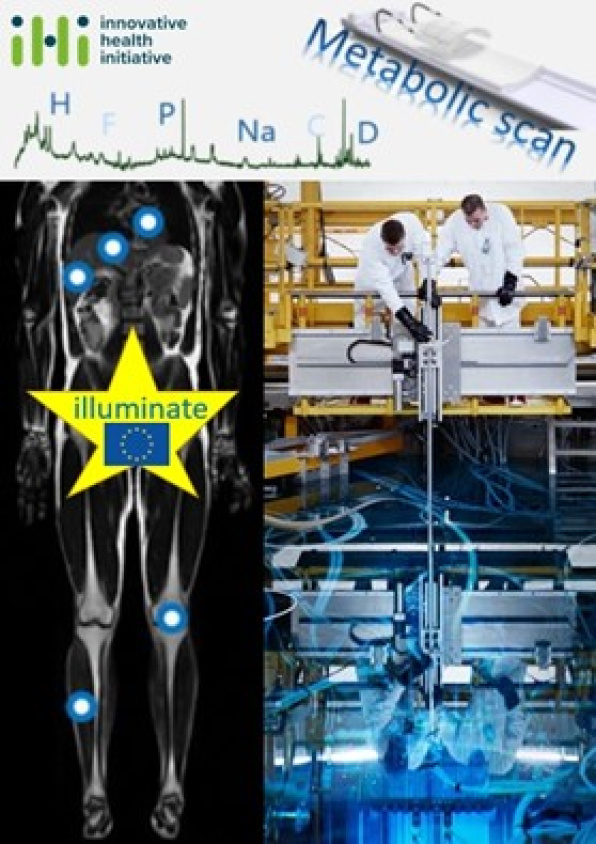
ILLUMINATE is a public-private partnership funded by the IHI, with representation from MedTech companies, research institutes, university hospitals and small- and medium-sized enterprises. The partners involved in the project are UMC Utrecht, Euro-Bioimaging ERIC, Philips Medical Systems Nederland BV, Philips Gmbh Innovative Technologies, Synlab Sdn Spa, Consiglio Nazionale Delle Ricerche, University of Turin, Bracco Imaging Spa, Tesla Dynamic Coils BV, Wavetronica BV, Lund University, NRG PALLAS, Amsterdam UMC, University Hospital Essen, Lygature.
Find out more about ILLUMINATE on the project website here.
Acknowledgement of support
This project is supported by the Innovative Health Initiative Joint Undertaking (IHI JU) under grant agreement No 101172722. The JU receives support from the European Union’s Horizon Europe research and innovation programme and COCIR, EFPIA, Europa Bío, MedTech Europe, and Vaccines Europe.
