News
UNITE4TB Community Advisory Group holds inaugural meeting
The UNITE4TB Community Advisory Group (CAG), which has been established to represent the views of the TB community at all stages of the project, met for the first time on Wednesday 16 February.
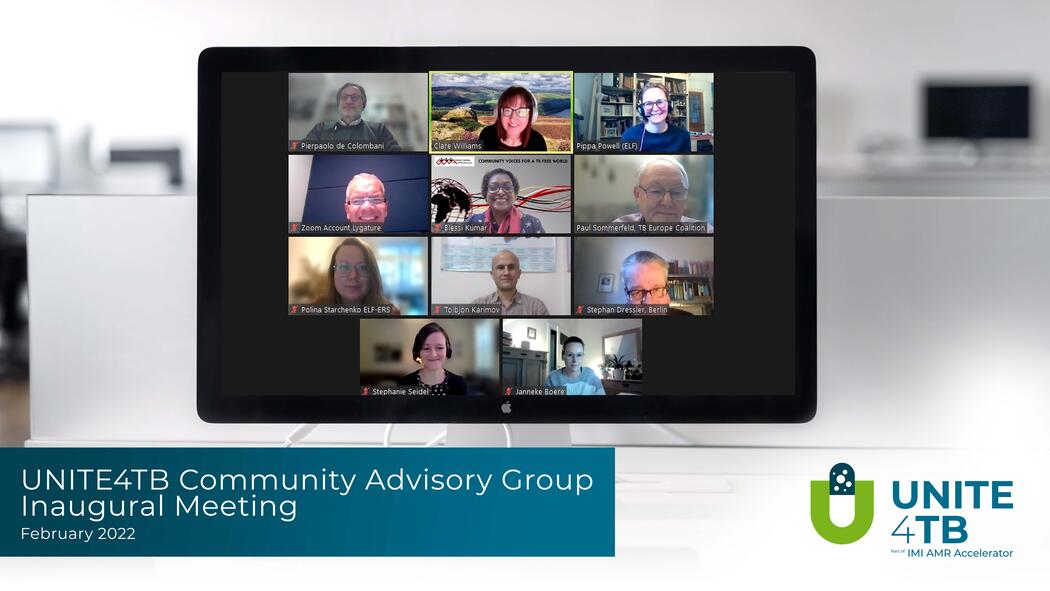
Held online, the meeting was attended by the five current members of the CAG together with representatives from several consortium partner organizations. It provided an opportunity for everyone to get to know each other and for the CAG members to understand more about UNITE4TB.
In addition to UNITE4TB project partners from the European Lung Foundation (ELF) and TB Alliance, the CAG consists of representatives from the Global Coalition of TB Advocates, the Global TB Community Advisory Board, the TB Europe Coalition, Stop TB Partnership Tajikistan, EU PEARL, TB Alert, and the European AIDS Treatment Group.
The CAG plans to meet approximately three times a year (virtually), allowing UNITE4TB project members to consult with the group and discuss challenges and opportunities for collaboration.
Commenting on the first meeting and the importance of the group for UNITE4TB, Pippa Powell from ELF, who provide the secretariat for the CAG, said: “It is essential that members of the TB community are centrally involved in the UNITE4TB project right from the start, ensuring that the views and insights of people living with TB and their families and advocates are heard and acted upon. We are absolutely delighted to have representatives of key TB community and advocacy groups as part of the UNITE4TB CAG, and everyone was excited to learn more about what impact the project could have and how we can work together to achieve it.”
A second meeting will soon be arranged to discuss and agree upon the role of the CAG and how the group will work together. The group also hopes to meet face-to-face at the UNITE4TB Annual Meeting in Munich in May.
--
This news item was originally published on the UNITE4TB website. Lygature supports UNITE4TB with overall program management and utilizes its management capabilities to ensure that the project delivers optimal results. For more information on our role, follow this link.
Acknowledgment of support
This project has received funding from the Innovative Medicines Initiative 2 Joint Undertaking (JU) under grant agreement No 101007873. The JU receives support from the European Union’s Horizon 2020 research and innovation programme and EFPIA, Deutsches Zentrum für Infektionsforschung e. V. (DZIF), and Ludwig-Maximilians-Universität München (LMU). EFPIA/AP contribute to 50% of funding, whereas the contribution of DZIF and the LMU University Hospital Munich has been granted by the German Federal Ministry of Education and Research.