

Projects
Non-Biological Complex Drugs (NBCD) Working Group
Towards aligned, science-based approval and post-approval standards for non-biological complex drugs

The Non-Biological Complex Drugs Working Group was established in 2009, to stimulate discussion of the safety and efficacy of NBCD innovation and follow-on products.

15
papers, 3 blogs and 1 book published

5
partners from industry and academia

About NBCDs
Non-biological complex drugs (NBCDs) consist of different (closely related and often nanoparticulate) structures that cannot be fully quantitated and characterized by physico-chemical analytical means. Examples include glatiramoids, iron-carbohydrate complexes, polymeric micelles, complex ocular emulsions and liposomes. The complex nature of NBCDs means that minute variations in the manufacturing process can substantially change the composition of final products, and this poses a challenge for the development of regulatory guidelines. The working group aims to ensure patient benefit through a science-based approach for the approval of NBCD products and follow-on versions.
For more information visit our website.
Key publications
- Klein, K., Borchard, G., Shah, V.P., Flühmann, B., McNeil, S.E. and de Vlieger, J.S.B. (2021), A pragmatic regulatory approach for complex generics through the U.S. FDA 505(j) or 505(b)(2) approval pathways. Ann. N.Y. Acad. Sci.. https://doi.org/10.1111/nyas.14662
- K.Klein, P.Stolk, M.L.De Bruin, H.G.M.Leufkens, D.J.A.Crommelin, J.S.B.De Vlieger. The EU regulatory landscape of non-biological complex drugs (NBCDs) follow-on products: Observations and recommendations. European Journal of Pharmaceutical Sciences, Volume 133, 15 May 2019, Pages 228-235.
- de Vlieger, J.S.B., Crommelin, D.J.A., Tyner, K. et al. Report of the AAPS Guidance Forum on the FDA Draft Guidance for Industry: “Drug Products, Including Biological Products, that Contain Nanomaterials”. AAPS J 21, 56 (2019).
- Hussaarts et al. Equivalence of complex drug products: advances in and challenges for current regulatory frameworks; Ann N Y Acad Sci Apr 26. [Epub ahead of print] (2017)
- Crommelin and de Vlieger, 2015 (Eds.), Non-Biological Complex Drugs. The Science and the Regulatory Landscape; AAPS/Springer, Advances in the Pharmaceutical Sciences Series, NY.
- Crommelin et al. Different pharmaceutical products need similar terminology; AAPS J. 2014 Jan;16(1):11-14.
- Schellekens et al. How to Regulate Nonbiological Complex Drugs (NBCD) and Their Follow-on Versions: Points to Consider; AAPS J. 2014 Jan;16(1):15-21.
A list of NBCD-related publications co-authored by Lygature can be found on this page.
Driving science-based discussions
The NBCD Working Group was established following a scientific workshop organized by TI Pharma – now Lygature. The partnership brings together both industry partners and international experts, who engage in debate with a wide range of relevant stakeholders. Lygature provides the necessary support and scientific expertise, to ensure that discussions are inclusive and productive. Activities include:
- Scientific management. Lygature is responsible for scientific management and organizational aspects of the working group as a whole. Responsibilities include general project management, management of strategic alliances and alignment with relevant stakeholders.
- Provider of neutral ground. As an independent third party with no commercial interest, Lygature has hosted the NBCD Working Group from the beginning, and provides neutral ground to facilitate discussion between stakeholders.
- Communication & dissemination. An important contribution by Lygature is communication and dissemination, with the aims of establishing terminology and creating awareness of the challenges faced. Activities include: presenting at international conferences; (co-)writing of scientific articles, white papers and blogs; organization of conferences; and brand building.
The NBCD Working Group contributes strongly to Lygature’s mission of accelerating the launch of medicines that improve society's wellbeing. Since stakeholders often have different interests, the project has required extensive management capabilities, along with expertise in both science and the regulatory landscape.
Lygature together with

Project updates
-

NBCD events this spring in Europe and the USA
The rise of bio- and nano-technologies has accelerated the development of complex medicines, and at the same time has revealed new hurdles in regulatory science and accelerating patient access to new therapies. To advance research and build consensus, the Non Biological Complex Drugs (NBCD) Working Group encourages discussion between key stakeholders from academia, regulatory bodies, industry, and drug manufacturing. On May 13, the group will co-host an event on Complex Medicines at the New York Academy of Sciences in New York. The day after, in Brussels, members of the group will speak at the RAPS Regulatory Conference – Europe 2019.
The NBCD Working Group, the Nanotechnology Characterization Laboratory, and the New York Academy of Sciences (NYAS) will present the conference Complex Medicines: Science, Regulation, and Accelerating Development to stimulate this discussion. This convening is a follow up to the 2016 event, Equivalence of Complex Drug Products: Scientific and Regulatory Challenges.
The conference will identify the best scientific approaches for complex medicines development and regulation, will outline outstanding challenges in the assessment of equivalence, and will discuss how to improve timely patient access for new medicines and building a sustainable healthcare system. The end goal is to facilitate the translation of scientific findings into advancements in medicine for the benefit of patients.
Click here for more information or to register for the NYAS Event.
Members of the working group will be present at the Regulatory Affairs Professionals Society (RAPS) Regulatory Conference in Brussels. They will chair and speak at a session on how to deal with global ambiguity in regulation of NBCD follow-on products. The session aims to identify the regulatory challenges for the approval of NBCD follow-on versions and discuss the impact of future alignment among regulatory agencies.
Click here for more information or to register for the RAPS Regulatory Conference.
-
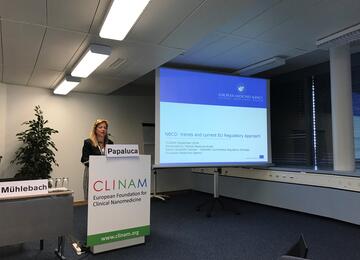
Global clinical experience with NBCDs: are we closer to regulatory alignment?
Prof. Daan Crommelin and Prof. Stefan Mühlebach from the NBCD Working Group chaired an interesting session about the global clinical experience with NBCDs and their follow-on versions at the 11th edition of the European Foundation for Clinical Nanomedicine (CLINAM) summit in Basel. In this session, speakers from FDA, EMA, Health Canada and knowledge institutions among others, discussed steps that are taken to globally align the regulatory process for NBCDs and what can be learned from recent experience in this field.
The session was started by Lygature’s Dr. Jon de Vlieger, Coordinator of the NBCD Working Group, who pointed out the importance to engage all stakeholders, from regulators to academia and manufacturers, in the discussions on how regulatory views can be aligned at the global level.
In the following presentation, Dr. Katherine Tyner from the FDA highlighted that the FDA has several class- and product-specific guidance documents already in place for a number of NBCDs. For example, a guidance document for liposomal drug products was just finalised last year. In addition, a “pre-ANDA program” has been set up to promote a more efficient and effective review process, involving early discussions of regulators with companies. Recently, FDA issued a draft guidance named Formal Meetings Between FDA and ANDA Applicants of Complex Products Under GDUFA.
Scientific guidance for a number of NBCDs is also available at the EMA, as was mentioned by Prof. Dr. med. Marisa Papaluca (EMA). However, global alignment is needed to prevent NBCD manufacturers being confronted with different data requirements when seeking approval in different global jurisdictions. To this end, the EMA has approached the FDA to understand US requirements for NBCD follow-on products and highlighted their support to engage in a reflection on a global development approach for NBCDs.
Health Canada will also be joining international initiatives related to nanotechnology and nanomedicines, as was stated by Dr. Michael Johnston (Health Canada). Health Canada has also implemented scientific advice meetings to guide companies early in the drug development process. However, Health Canada is relying on existing regulations and a case-by-case approach to regulate NBCDs follow-on products, as specific guidance documents in Canada are not expected until 2020.
The session was concluded by Prof. Dr. Henning Blume (EUFEPS and SocraTec C&S) and Dr. Scott E. McNeil (NCL), both presenting scientific data stressing the need for global alignment of bioequivalence criteria and definitions of critical quality attributes.
There is an enormous opportunity for a science-based regulatory approach for NBCDs and their follow-on products combining collective intelligence from global regulatory authorities. Further strengthening the dialogue about NBCDs at the global level can facilitate a harmonized approach for the co-creation of efficient guidance that ultimately can have a global impact on patients.
-
Register now for the AAPS Workshop on FDA’s draft guidance for nanomedicine
This September, the American Association of Pharmaceutical Scientists (AAPS) organizes a Guidance Forum workshop to discuss challenges, issues, and concerns related to the U.S. Food and Drug Administration (FDA) draft guidance for drugs and biological products that contain nanomaterials. The forum takes place on 11 September in Silvers Spring, Maryland.
The workshop will feature plenary speakers and have breakout-style sessions on several topics. This format will provide ample opportunity for participants to engage in open dialogue with regulators, academia and industry scientists, with the goal of providing insight into the guidance for submission of regulatory applications. Several members of the NBCD working group (Vinod Shah, Daan Crommelin, Sesha Neervannan, Scott McNeil and Jon de Vlieger) will take an active part, either as chair, speaker or moderator.
Participants of this event will:
- Understand the critical quality attributes (CQA) and regulatory pathway for drug products with nanomaterials.
- Discuss CQA and different aspects of regulatory pathways.
- Gain insight into problems and issues encountered during the drug discovery process and the interface between drug discovery and development.
- Gain insight into the guidance for submission of regulatory applications.
You can view the detailed agenda online, or register directly through the AAPS website. If you are interested in meeting the NBCD Working Group, please contact Jon de Vlieger (NBCD Working Group Coordinator) at jon.devlieger[at]lygature.org.
The draft guidance was issued in December 2017, and has been developed to provide industry with the Agency's current thinking for the development of human drug products, including those that are biological products, that contain nanomaterials. The FDA requested public comments on the draft guidance, and on behalf of the NBCD Working Group, Lygature submitted a comment, as did 12 other organizations.