

Projects
Pediatric Praziquantel Consortium
Developing and providing a pediatric formulation of the drug praziquantel, to treat schistosomiasis in preschool-aged children
Latest project updates
- First Preschool-Aged Child Treated with the Pediatric Praziquantel Consortium’s New Pediatric Treatment for Schistosomiasis
- Technology transfer of new pediatric treatment option for schistosomiasis advances in Brazil
- New pediatric treatment option for preschoolers with schistosomiasis now included in WHO List of Prequalified Medicines
The Pediatric Praziquantel Consortium targets preschool-aged children with schistosomiasis, a parasitic disease that affects more than 240 million people worldwide. The consortium was established in July 2012 and uses an innovative R&D operating model that builds new partnerships as needed and shares development risks.

14
partners since 2021

12 years
duration of the program


About the Pediatric Praziquantel Consortium
Praziquantel (PZQ), the gold standard treatment for schistosomiasis, is currently available in large oral tablets that are suitable only for adults and school-aged children. Due to the size of the tablet, its bitter taste, and a lack of clinical data, an appropriate treatment for very young children does not exist. The consortium addresses this issue and has developed a new orally disintegrating PZQ formulation known as arpraziquantel. With the full clinical development phase successfully completed in 2021, the program has entered the regulatory filing stage, while preparing for the potential delivery of arpraziquantel through the consortium’s dedicated access program, ADOPT. The consortium is supported by grants from the Bill and Melinda Gates Foundation in 2013, the Global Health Initiative Technology Fund in 2013, 2014, 2016, 2019 & 2021, and the European & Developing Countries Clinical Trials Partnership (EDCTP) (2018 & 2021), under its second program supported by the European Union. Visit the Pediatric Praziquantel Consortium website for more information about the program.
Bridging industry interests and societal needs
Lygature helped to set up the consortium and fulfills an independent ‘broker’ role, a key ingredient of successful public-private development partnerships. Reflecting the consortium’s position at the crossroad between industry and society, the contributions being made by Lygature from January 2016 include:
- Coordination and governance. As consortium coordinator, Lygature provides necessary governance in terms of monitoring progress, finance, IP management, and collaborations. In addition, it successfully takes the lead in fundraising to support the Development and Access programs (current total value: EUR 5m).
- Communication and dissemination . Lygature pro-actively coordinates the engagement with key stakeholders to share the consortium’s ambition to make a meaningful contribution to tropical medicine and health innovation in endemic countries. Responsibilities include (but are not limited to): presenting at (inter)national conferences; writing of (scientific) articles and news items; and development of the consortium’s communication strategy, website, and visual identity and social media management.
The Pediatric Praziquantel Consortium is an example of the Lygature mission to bring together public and private partners, and so to make a meaningful contribution to global health. The project relies heavily on Lygature’s expertise in both management and science. In addition, Lygature has helped to ensure that each partner’s needs, interests, and objectives are met.
Lygature together with
Merck KGaA (Darmstadt, Germany), Astellas Pharma Inc. (Japan) , Swiss Tropical & Public Health Institute , Farmanguinhos, Unlimit Health, KEMRI, UFHB, Technischen Universität München, African Institute for Health and Development, Ministry of Health in Côte d’Ivoire, Ministry of Health in Kenya, Ministry of Health in Uganda, Makerere University School of Public Health
Project updates
-
World NTD Day 2024: Unite. Act. Eliminate
Today, 30 January, marks World Neglected Tropical Diseases Day, one of 11 Global Health Days recognized by the World Health Organization (WHO). As an international public-private partnership fighting to eliminate schistosomiasis, one of 21 Neglected Tropical Diseases (NTDs) classified by the WHO, we are proud to show our support. Read more.
-
The European Medicines Agency adopts positive opinion of our treatment option for schistosomiasis in preschool-aged children
The Pediatric Praziquantel Consortium is proud to announce a new milestone: The European Medicines Agency (EMA) has adopted a positive scientific opinion of our new pediatric treatment option for preschool-aged children with schistosomiasis. Read more.
-
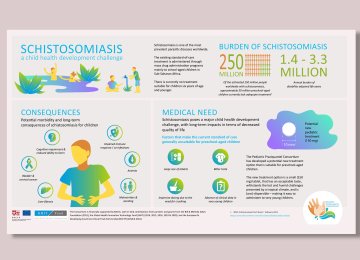
Schistosomiasis: a child health development challenge
Early childhood, the period from birth to age 8, is recognized as a critical phase of intense physical and cognitive growth. Infants and children facing health challenges during this time may suffer detrimental and long-lasting health consequences. Efforts to improve early childhood development in sub-Saharan Africa may be undermined due to diseases such as schistosomiasis not being considered among the factors impacting this crucial life stage.