

Projects
RADAR-CNS
Wearable devices that help prevent and treat depression, multiple sclerosis and epilepsy

The RADAR-CNS project aims to develop new ways of monitoring major depressive disorder, epilepsy, and multiple sclerosis using wearable devices and smartphone technology. Such widely available devices can reveal a patient’s current condition, remotely, at previously unachievable levels of detail. A project consortium of 24 includes commercial and academic partners from across Europe and the US.

€ 25 M
funding from IMI, EFPIA

22
partners in Europe and the US

About RADAR-CNS
RADAR-CNS* is jointly led by King’s College London and Janssen Pharmaceutica NV, with funding from the Innovative Medicines Initiative (IMI) and contributions in-kind from commercial partners. Its goal is to predict and pre-empt relapses in patients with major depressive disorders, epilepsy, and multiple sclerosis, and to improve their quality of life. The consortium brings together experts from diverse fields including clinical research, engineering, computer science, information technology, data analytics and health services. Both patients and health care providers will be involved.
*RADAR-CNS: Remote Assessment of Disease and Relapse – Central Nervous System
Managing of a multi-disciplinary program, combined with data analysis and regulatory expertise
Lygature, is a member of the Management Team. In addition, together with linked partner The Hyve, Lygature is leveraging expertise developed during its Translational Research IT (TraIT) project to address the data analysis challenge. It is also looking at regulatory issues and ways in which such devices can be qualified.
- Coordination and communication. Lygature is co-lead of the Project Management work package in RADAR-CNS and coordinates this large and multi-disciplinary program on a day-to-day basis. Activities include monitoring the effective execution of the work plan and its progress, creation and alignment of work processes, resource management and internal communication. In addition, Lygature provides the backbone for knowledge sharing and is responsible for the design and development of the public website.
- Data analysis. RADAR-CNS requires ground-breaking work to isolate successfully normal biosignatures, as recorded by wearable devices. Patients are being followed from doctors’ perspectives, for correlation with device data. Lygature is using its data management expertise to integrate data from various sources, relating werables-derived data to disease symptoms and allowing scientists to assess if measured changes are predictive.
- Regulatory requirements. The project is also exploring new territory around regulation, posing important questions concerning the use of everyday devices for medical monitoring. Lygature will be looking at how such devices will be deployed, what requirements need to be met and how they can be qualified across different jurisdictions for this application.
The contribution made by Lygature to RADAR-CNS is an example of how cross-disciplinary expertise built up during major projects can be applied in new areas. An ability to extract meaningful data from complex data sets has been proven during the TraIT project, and the Lygature team offers, through its Escher platform, all of the experience needed to overcome diverse regulatory hurdles.
Lygature together with
King's College London, Provincia Lombardo-Veneta - Ordine Ospedaliero di San Giovanni di Dio, Università Vita-Salute San Raffaele, Fundacio Hospital Universitari Vall d'Hebron - Institut de Recerca, University of Nottingham, Centro de Investigacion Biomedica en Red, Software AG, Region Hovedstaden, Stichting VU-VUmc, Universitaetsklinikum Freiburg, Stichting imec Nederland, Katholieke Universiteit Leuven, Northwestern University, Universität Passau, Università degli Studi di Bergamo, Charité, Intel Corporation (UK) Ltd, GABO:mi Gesellschaft Fur Ablauforganisation:Milliarium Mbh & Co Kg, Janssen Pharmaceutica NV, Biogen Idec Limited, H. Lundbeck A/S, UCB Biopharma SPRL, MSD IT Global Innovation Center s.r.o.


Acknowledgement of support
RADAR-CNS receives funding from the Innovative Medicines Initiative 2 Joint Undertaking under grant agreement No 115902. This Joint Undertaking receives support from the European Union’s Horizon 2020 research and innovation programme and EFPIA. See www.imi.europa.eu for more details.
Project updates
-
RADAR-CNS highlighted at EFPIA presentation to the European Parliament
In November 2017, Magda Chlebus, Executive Director, Science Policy & Regulatory Affairs, European Federation of Pharmaceutical Industries and Associations (EFPIA), spoke to members of the European Parliament about RADAR-CNS.
-

Calling healthcare professionals: collaborate with RADAR-CNS
Healthcare professionals are being invited to register their interest in participating in RADAR-CNS (Remote Assessment of Disease and Relapse – Central Nervous System), a major new international research programme exploring the potential of wearable technology to help monitor and prevent epilepsy, multiple sclerosis (MS) or depression. Read more.
-
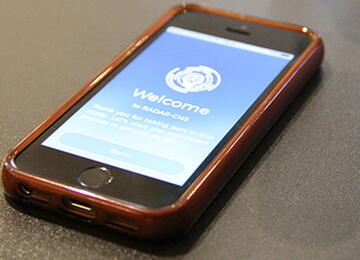
Help RADAR-CNS develop a new mobile health app
People with depression, epilepsy and multiple sclerosis (MS) are being asked to contribute to a major research project by completing a five-minute survey on health technology. Read more