

Projects
Trials@Home
A consortium exploring the opportunities of moving clinical trials from the traditional clinic setting to the participant's immediate surroundings

Trials@Home aims to explore the potential of digital technologies for use in ‘remote decentralised clinical trials’ (RDCTs). The aim is to develop and test methods to streamline data collection as well as patient recruitment and retention.

€ 40,6 M
funding from IMI and EFPIA

31
partners
About the Trials@Home project
In a conventional clinical trial, patients have to make regular trips to the clinic for check-ups to monitor their condition. Many patients are understandably put off by the distance to the clinic and how often they would be expected to make the trip, and many patients who initially join trials drop out for logistical reasons.
Trials@Home aims to explore the potential of digital technologies for use in ‘remote decentralised clinical trials’ (RDCTs). They will develop and test methods to streamline data collection as well as patient recruitment and retention.
If successful, RDCTs could make it easier to recruit and retain larger numbers of patients, including people from groups that are often under-represented in trials. Furthermore, as data collection would be more or less continuous, the results would be more reliable and more representative of the real world.
If you would like to find out more, visit the Trials@Home website.
Trials@Home ambitions
- Defining the best practices for the conduct of RDCTs.
- Identifying technologies and other operational innovative approaches for RDCTs and selecting the appropriate technology package to be used for the pan-EU pilot.
- Designing and running a pan-EU pilot, comparing the scientific and operational quality of the RDCT with traditional trial approaches and evaluating the feasibility of the RDCT.
- Identifying, mapping and analysing the relevant ethical, quality, regulatory, legal and organisational barriers and enablers of RDCTs.
- Consulting with stakeholders and promoting the outcomes from the Trials@Home consortium through targeted communication, dissemination and training activities.
- Providing recommendations with supporting tools for implementing RDCTs in Europe and contributing to the update of ICH guidelines on RDCTs.
Lygature in Trials@Home
Providing expertise (a dedicated platform) to internal project communication) and various important deliverables like the Data management Plan, the Sustainability plan etc.
- Internal Project Communication. Lygature is responsible for delivering and maintaining the proprietary “MyProjectPlaza” communication platform. This ensures transparency, efficient clarification and fine-tuning among partners.
- Data management and other plans. Lygature supports delivering the Data Management Plan, the Project Sustainability plan etc. The DMP will contain key instruments for an effective storage and (re-)use of all generated data.
Lygature together with
Allergan, AstraZeneca, Bayer, Boehringer Ingelheim, CERTH-I, Covance, DREEM, eCLINICALHEALTH, FISABIO, IDF Europe, IQVIA, Janssen, JOANNEUM, Julius Clinical, Medlaw, Medtronic, MRN, Novartis, Pfizer, Sanofi, Syddansk Universitet, Takeda, Teva Pharmaceutical Industries Limited, UCB, UMCU, University of Dundee, University of Oxford, University Utrecht, UPPMD, Vital Transformation.


Acknowledgement of support
The research leading to these results has received support from the EU/EFPIA Innovative Medicines Initiative [2] Joint Undertaking (H2020-JTI-IMI2) Trials@Home grant n° 831458.
Project updates
-
First set of recommendations for RDCTs (D1.1)
Clinical trials are a crucial step in the development and testing of medical treatments. They are essential to ensure that new treatments are safe and effective.
Traditionally, clinical trials have taken place in hospitals or other research sites, often requiring participants to attend several face-to-face study visits. While these trials produce results, they can do so at a great burden to participants and risk excluding people who are unable or unwilling to travel to study visits.
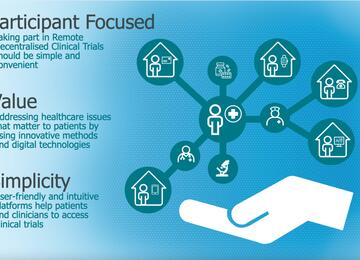
Remote decentralised clinical trials (RDCTs) are one way to make trials more accessible. RDCTs are centred around participants. Using technology can allow people to take part in clinical trials in their own home with no need to travel to attend study visits or to take substantial time off work or away from family. RDCTs have the potential to make taking part in a clinical trial simple and convenient.
-
Innovative Medicines Initiative Launches ‘Trials@Home’
The Trials@Home consortium will explore the opportunities of moving clinical trials from the traditional clinic setting to the participant›s immediate surroundings. These so-called Remote Decentralised Clinical Trials (RDCTs) make use of new – digital – innovations and enable participants to visit a clinical trial centre less frequently, if at all. This makes it easier for larger, more diverse and remote populations to participate in clinical trials.